
How to Learn Boxing at Home
You can learn the basics of boxing at home: the stance, the guard, the six punches, short combos, simple footwork, and the fitness to box a few rounds. You need 2 to 3 meters of floor and no gear. Sparring, real defense, and the fine points of technique still need a coach or a partner.
Key points
- At home you learn by shadow boxing: real punches thrown at the air, in timed rounds, with your guard up.
- Learn the punches in the order clubs teach them: jab and cross first, then hooks and uppercuts.
- Shadow boxing needs no gear. A bag needs hand wraps and gloves.
- Nobody is there to correct you, so check yourself in a mirror, on video, or with Guardia.
Can you learn boxing at home?
Yes, the basics. Boxing is built from a few movements: a stance, a guard, six punches, and small steps. A beginner class teaches them one at a time and repeats them until they feel natural. The repeating is the part you can do alone, in a living room, with nobody holding pads.
Some skills need another person. You learn defense by reacting to punches that are really coming at you, and you learn distance by facing someone who moves. A coach also sees small mistakes you cannot feel yet.
| Skill | Alone at home? | Why |
|---|---|---|
| Stance and guard | Yes | A mirror shows your feet, your hands, and your chin. |
| The six punches | Yes | Shadow boxing teaches the path of each punch and the way back to your chin. |
| Combos | Yes | Start with 1-2 and add one punch at a time. |
| Basic footwork | Yes | Short steps in, out, and to the side need only floor space. |
| Fitness for boxing | Yes | Rounds with short rests build the stamina to keep your hands up. |
| Fine technique | Partly | Video catches the big mistakes. A coach catches how your weight moves and when your hips turn. |
| Defense against punches | No | Slips and blocks need someone throwing at you to teach the timing. |
| Sparring | No | Spar only at a club, with a coach watching and the right gear on. |
How much space and gear you need
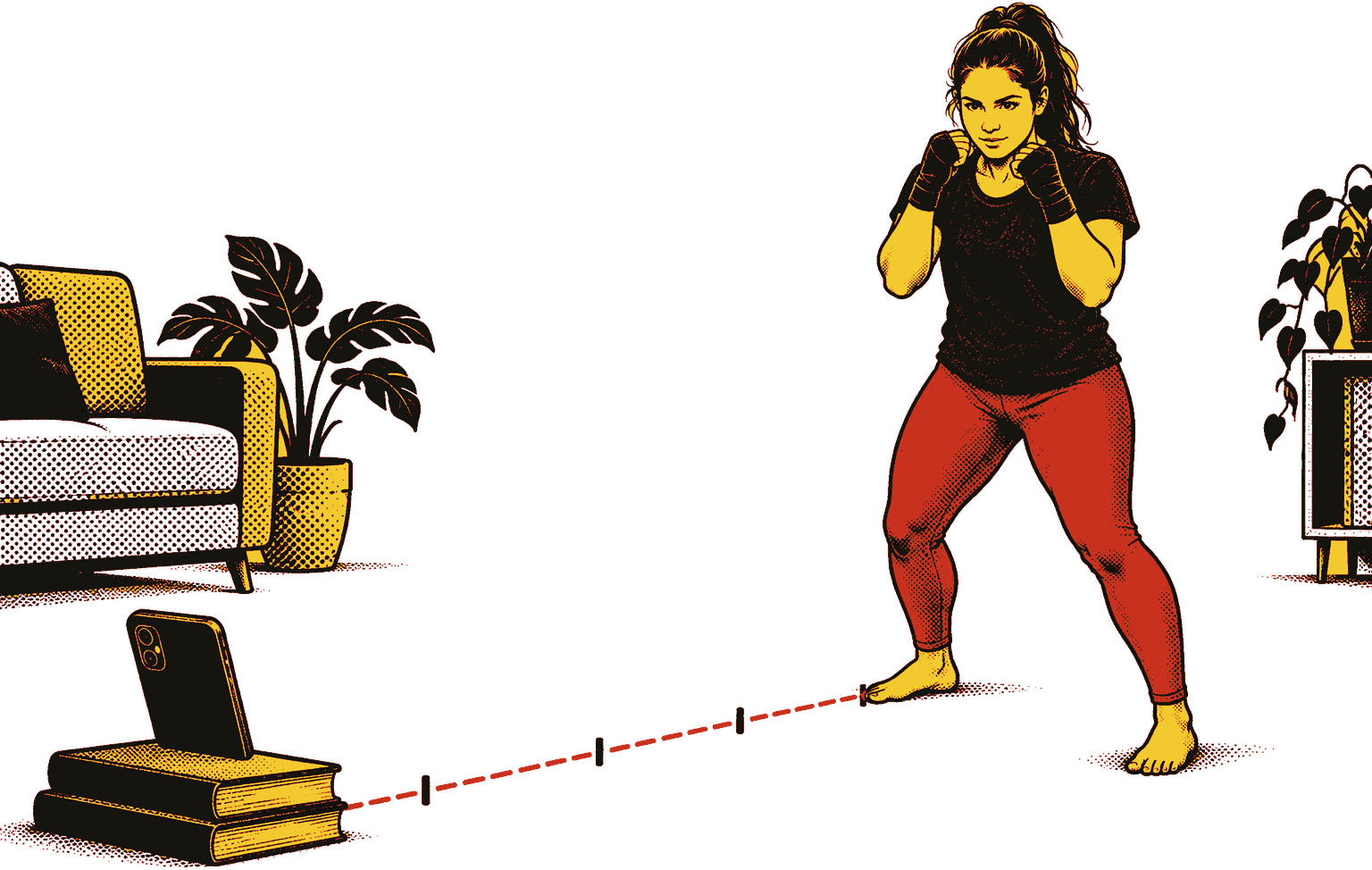
Clear 2 to 3 meters of floor in front of you and about an arm's length on each side, so you can step forward and back without hitting furniture. Move any rug that slides. That is also the distance Guardia's camera needs to see your upper body and both hands.
- Shadow boxing: nothing. Comfortable clothes and a floor you will not slip on.
- A bag: hand wraps and boxing gloves, every time. Never hit a bag with bare hands.
- Useful extras: a mirror, and a round timer. The boxing round timer runs your rounds and rest with a bell.
How to box at home without a bag
Shadow box: throw real punches at an imaginary opponent, move your feet, and keep your guard up, in rounds with rest between them. With nothing to hit, all your attention goes to your form.
Picture someone your height, an arm's length away, and aim at their chin. Throw at a speed you can control, and stop each punch just short of a locked elbow. Bring every punch back to your chin before the next one goes. The shadow boxing guide has the steps, the common mistakes, and a 15-minute workout.
Start with your stance and guard
Right-handers usually stand orthodox, with the left foot forward. Left-handers usually stand southpaw, with the right foot forward. If you are not sure, start orthodox.
- Stand with your feet about shoulder-width apart, then step your lead foot forward until your rear toes are about level with your lead heel.
- Turn your rear foot out a little and lift its heel slightly. Bend both knees.
- Bring both fists to your chin, elbows in against your ribs.
- Tuck your chin a little and keep your eyes forward.
Hold it for a whole round before you throw anything. The guard guide goes deeper, for both stances.
Learn the six punches by number
Coaches call punches by number, so you hear a combo and throw it without thinking of names. Odd numbers are lead-hand punches, even numbers rear-hand punches.
| Number | Punch | Orthodox hand | Southpaw hand |
|---|---|---|---|
| 1 | Jab | Left | Right |
| 2 | Cross | Right | Left |
| 3 | Lead hook | Left | Right |
| 4 | Rear hook | Right | Left |
| 5 | Lead uppercut | Left | Right |
| 6 | Rear uppercut | Right | Left |
Each punch in the table links to its own guide. The boxing numbers chart puts all six on one page.
Footwork basics you can practice in a room
Footwork keeps your stance under you while you move. At home, learn the step and drag:
- To move forward, step with your lead foot, then bring your rear foot the same distance.
- To move back, step with your rear foot first, then your lead foot.
- To move to the side, the foot on that side moves first.
- Keep the steps short and your feet at the same width. Never cross them.
Try one round of footwork only, hands up: two steps forward, two back, two to each side, and again.
A 4-week plan for beginners at home
Learn the punches in the order a beginner class teaches them, one family a week: the jab and cross, then the hooks, then the uppercuts, then all six together. Rounds start at 1:30 and grow to 2:30, with 45 seconds of rest, 2 to 5 days a week.
The 4-week boxing workout plan has the combos for each week, the timer settings, when to move up a week, and a free one-page PDF to print.
How to get feedback at home
A big part of a coach's job is pointing out the mistake you cannot feel. At home you need another way to see it.
A mirror
Face the mirror to check your guard, then turn side-on to see the path of each punch. After every punch, look for three things: both fists back at your chin, chin down, feet still at their width.
A video of yourself
Record one round from the front and one from the side with your phone's camera app. Play it back slowly and compare each punch with its guide, starting with the jab. Video shows what a mirror hides, like the hand that drops while the other one punches.
Guardia
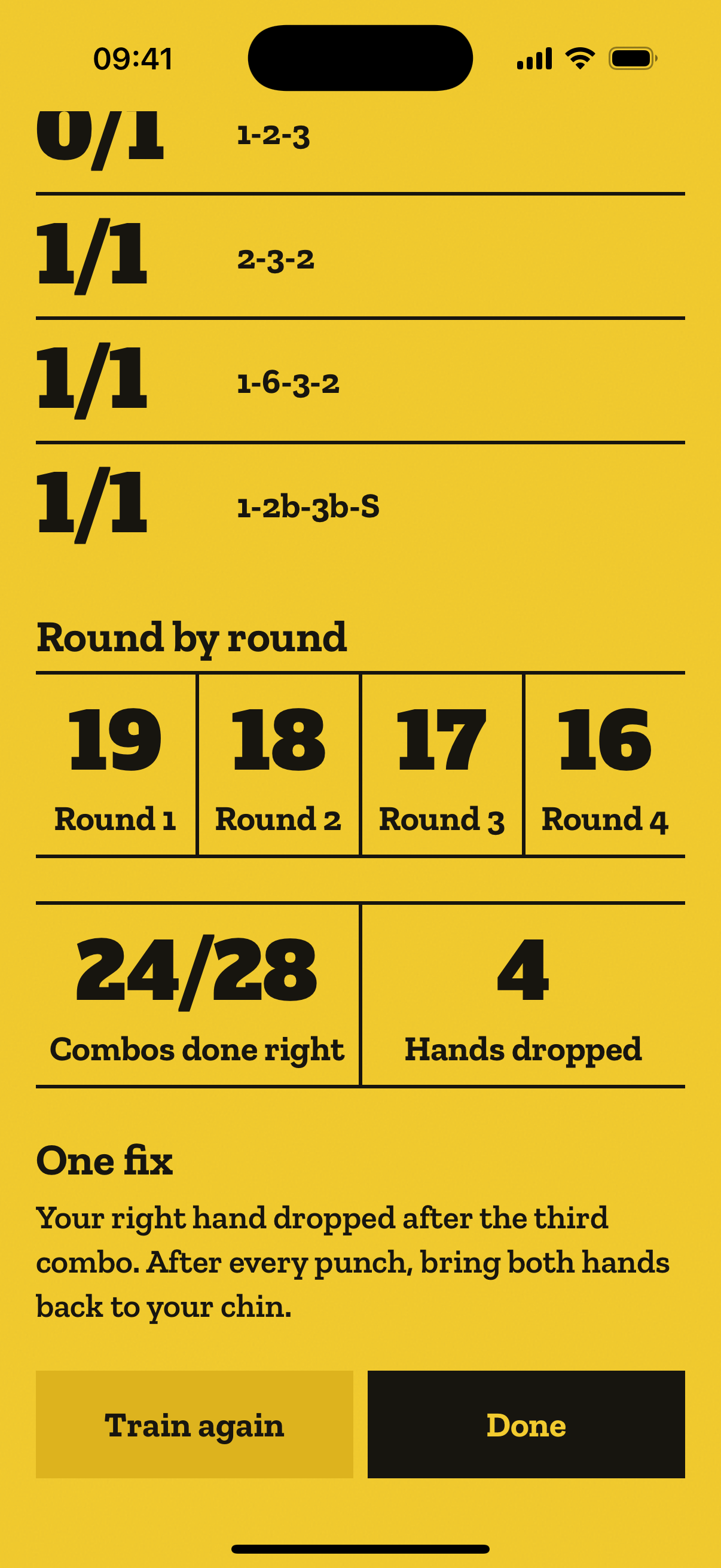
Prop your iPhone up 2 to 3 meters away and face it. The coach calls each combo out loud, in English or Spanish, by name or by number. The front camera follows your body, and the phone counts and names each punch as you throw it. When a hand drops, the guard check tells you which one. After each round you get one fix to work on.
The coach also calls slips and rolls inside the combos, and the camera checks that your head moves. The phone does the counting, and video never leaves your phone: what stays on the phone.
Safety before you start
- New to exercise, or have a heart, joint, or other health condition? Check with a doctor first. The free PAR-Q+ questionnaire tells you whether you should.
- Warm up for 5 to 10 minutes: easy steps, arm circles, slow shadow boxing. A warm-up helps you move better and may lower injury risk.
- Clear 2 to 3 meters of floor in front of you. That is also the space the app's camera needs.
- Wrap your hands and wear gloves on a bag. In Great Britain's elite team, the hand was injured more than any other part of the body. Shadow boxing needs no gloves.
- Stop if you feel chest pain, dizziness, unusual shortness of breath, joint pain that does not settle, or numbness or swelling in a hand.
Questions about learning at home
Can you learn boxing without a coach?
You can learn the basics: stance, guard, the six punches, and short combos. You cannot learn to defend against real punches or to spar without one. A good path: start at home, then book a few sessions at a club so a coach can check what you built.
Can you learn boxing from YouTube?
Videos show what a punch should look like, and that helps. They cannot see you. Pair them with something that does: a mirror, a video of yourself, or an app that watches you through the camera.
Can I learn boxing at 40 or 50?
Shadow boxing lets you set your own pace, so age does not stop you from learning the basics. Fill in the PAR-Q+ first and see a doctor if it tells you to. Then start with short rounds, like week 1 of the 4-week plan, and add time slowly.
How hard is boxing for beginners?
The punches are simple to learn. The hard part is throwing them well when you are tired: hands drop, feet stop moving. That is why beginner rounds are short, with rest between them.
Sources
- Fradkin, Gabbe, and Cameron, 2006. Does warming up prevent injury in sport? The evidence from randomised controlled trials?. Journal of Science and Medicine in Sport.
- Loosemore and others, 2015. Boxing injury epidemiology in the Great Britain team: a 5-year surveillance study of medically diagnosed injury incidence and outcome. British Journal of Sports Medicine.
- PAR-Q+ Collaboration. The Physical Activity Readiness Questionnaire for Everyone (PAR-Q+). eparmedx.com.
Guardia calls the combos, counts every punch, and tells you when your guard drops.

Guardia
Shadow training and home workouts
For iPhone. Coaching in English or Spanish.