
30-Day Boxing Challenge
This 30-day boxing challenge is a calendar for beginners at home, with no gear: 13 short shadow boxing workouts and 17 rest days. On day 1 and day 30 you throw as many punches as you can in 20 seconds, so you measure the month in punches. The workouts follow Guardia's 4-week plan.
- Day 1 Week 1 Sprint
- Day 2 Rest
- Day 3 Week 1
- Day 4 Rest
- Day 5 Week 1
- Day 6 Rest
- Day 7 Rest
- Day 8 Week 2
- Day 9 Rest
- Day 10 Week 2
- Day 11 Rest
- Day 12 Week 2
- Day 13 Rest
- Day 14 Rest
- Day 15 Week 3
- Day 16 Rest
- Day 17 Week 3
- Day 18 Rest
- Day 19 Week 3
- Day 20 Rest
- Day 21 Rest
- Day 22 Week 4
- Day 23 Rest
- Day 24 Week 4
- Day 25 Rest
- Day 26 Week 4
- Day 27 Rest
- Day 28 Rest
- Day 29 Rest
- Day 30 Week 4 Sprint
Week 1 to 4: the workout of that week of the plan. Sprint: 20 seconds of punches before the workout.
Download the calendar as a PDFKey points
- 13 workouts of 6 to 12 minutes, plus a warm-up, with a rest day after each one.
- Each week adds something new: straights, then hooks, then uppercuts, then all six together.
- Day 1 and day 30 start with a 20-second punch sprint. You compare punches, not weight.
- Print the free calendar and cross off each day.
How the challenge works
The challenge is the first four weeks of Guardia's beginner plan, fitted into 30 days. You train 3 days a week, with a rest day after each workout: the start the plan suggests for most beginners. Each week adds something new and a little more time. Days 27 to 29 are rest days, so you start the final sprint on day 30 fresh.
| Days | Focus | Workout |
|---|---|---|
| 1 to 7 | Jab and cross | 3 rounds of 1:30, about 6 min |
| 8 to 14 | Add the hooks | 3 rounds of 2:00, about 8 min |
| 15 to 21 | Add the uppercuts | 4 rounds of 2:00, about 10 min |
| 22 to 28 | Put it together | 4 rounds of 2:30, about 12 min |
| 29 and 30 | Rest, then the final sprint | Sprint, then the week 4 workout |
Rest 45 seconds between rounds, and warm up for 5 to 10 minutes before each workout. The combos for each week, and how each round runs, are in the 4-week boxing plan.
Day 1: the 20-second sprint
The sprint is your starting number. After your warm-up, throw as many punches as you can in 20 seconds, then write the number in the first box of the calendar.
- Warm up first, for 5 to 10 minutes. The sprint is a full effort.
- Throw full punches. Reach out all the way, then bring the hand back. Half punches do not count.
- Use both hands. A fast 1-2 is the easiest, but every punch counts.
- Count them. Film the 20 seconds with your phone and count in slow motion, or ask someone to count.
- Rest 2 minutes, then do the day's workout.
New to exercise? The US physical activity guidelines tell people who are not active yet to avoid hard efforts at first. Skip the day-1 sprint and do your first one on day 8, after a week of workouts. Write it in the day-1 box anyway.
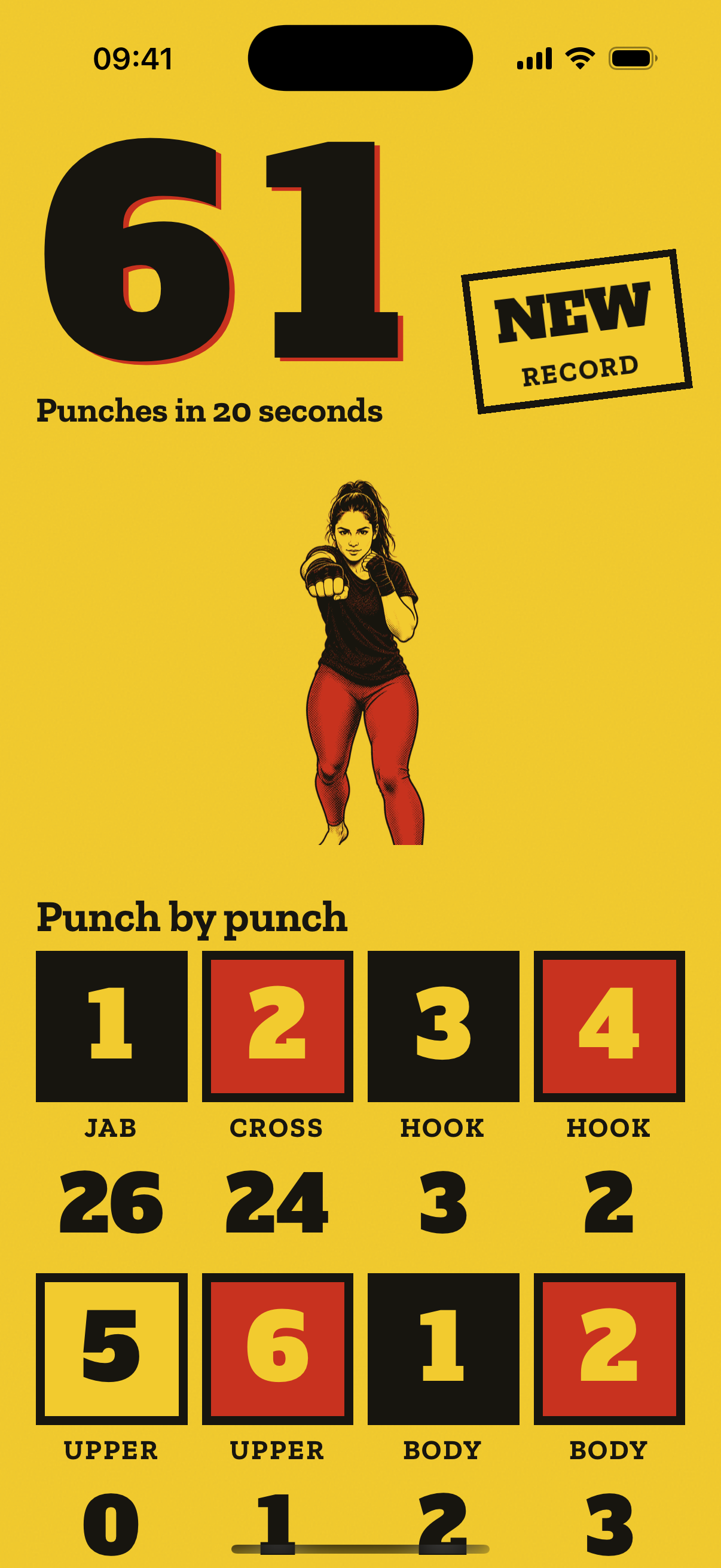
Guardia has the sprint built in: face the phone from 2 to 3 meters away, and the camera counts every punch and keeps your best.
Why punches, not weight
Thirty days is short, and a number on a scale moves for many reasons that have nothing to do with boxing. The sprint measures something boxing trains directly: how many full punches you can throw while keeping your form. That is why it opens day 1 and day 30.
Count only clean punches on both days, and stand the same way. A higher number with sloppy punches is not progress.
Rest days
Rest days are part of the challenge. Boxing works your shoulders, wrists, and calves in ways they are not used to, and your form holds better when you come back rested. The challenge also follows the advice of the health guidelines for people starting out:
- Start small and build up. The WHO guidelines say adults should start with small amounts of activity and increase how often, how hard, and how long over time. Here the rounds get longer each week.
- Spread it out. The US guidelines say that spreading activity across at least 3 days a week may help reduce the risk of injury and too much fatigue.
A walk is fine on a rest day. The workouts are short, so walking, cycling, or another sport on the other days helps you reach the WHO's weekly minimum of 150 minutes of moderate activity.
If a workout day comes and your shoulders or wrists still hurt, take another rest day and move the calendar by one day. Pain that stays or gets worse is a reason to stop and see a doctor.
Day 30: the second sprint
Warm up, run the sprint exactly as on day 1, and write the number in the last box. Then do the week 4 workout to close the month.
Compare the two numbers, and also look at how you threw them. On day 30 you should know all six punches by number, throw 4-punch combos, and keep your guard up through 4 rounds of 2:30.
Print the calendar
Download the 30-day calendar as a one-page PDF. It has a box for each day, the workout for each week, and two boxes for your sprint numbers. Tape it where you train and cross off each day, rest days too.
After day 30
Keep training 3 days a week, or 4 once that feels easy. Repeat week 4 until it feels easy, then change one thing at a time: longer rounds, up to 3 minutes, or longer combos. Do a sprint once a month to see the trend.
Want to hit something? Try a bag with hand wraps and gloves. The hand wrap guide has a picture of each stage.
Safety before day 1
- New to exercise, or have a heart, joint, or other health condition? Check with a doctor first. The free PAR-Q+ questionnaire tells you whether you should.
- Warm up for 5 to 10 minutes: easy steps, arm circles, slow shadow boxing. A warm-up helps you move better and may lower injury risk.
- Clear 2 to 3 meters of floor in front of you. That is also the space the app's camera needs.
- Wrap your hands and wear gloves on a bag. In Great Britain's elite team, the hand was injured more than any other part of the body. Shadow boxing needs no gloves.
- Stop if you feel chest pain, dizziness, unusual shortness of breath, joint pain that does not settle, or numbness or swelling in a hand.
Questions about the challenge
Can you learn boxing in 30 days?
You can learn the basics: the stance, the guard, the six punches, and short combos. Thirty days is not enough to learn defense against real punches or to spar. That takes a coach and a partner.
Should I box every day for 30 days?
Not as a beginner. Your shoulders, wrists, and legs need time to recover, and tired form teaches bad habits. This calendar has 17 rest days, and never 2 workouts in a row. A walk on a rest day is fine.
What if I miss a day?
Do the missed workout the next day, and move the rest of the calendar by a day. Do not do two workouts in one day to catch up. One missed day does not undo a habit: in a study of people building a new habit, missing one chance did not materially change how the habit formed.
Do I need gloves or a bag?
No. Every workout is shadow boxing: real punches thrown at the air. If you add a bag, wrap your hands and wear boxing gloves every time.
What counts as a punch in the sprint?
A full punch: your arm reaches out all the way and your hand comes back. Jabs and crosses are the easiest to count, but hooks, uppercuts, and body shots count too.
Sources
- World Health Organization, 2020. WHO guidelines on physical activity and sedentary behaviour. World Health Organization.
- US Department of Health and Human Services, 2018. Physical Activity Guidelines for Americans, 2nd edition. health.gov.
- Garber and others, 2011. Quantity and quality of exercise for developing and maintaining cardiorespiratory, musculoskeletal, and neuromotor fitness in apparently healthy adults. Medicine and Science in Sports and Exercise.
- Lally and others, 2010. How are habits formed: modelling habit formation in the real world. European Journal of Social Psychology.
- Fradkin, Zazryn, and Smoliga, 2010. Effects of warming-up on physical performance: a systematic review with meta-analysis. Journal of Strength and Conditioning Research.
- Fradkin, Gabbe, and Cameron, 2006. Does warming up prevent injury in sport? The evidence from randomised controlled trials?. Journal of Science and Medicine in Sport.
- PAR-Q+ Collaboration. The Physical Activity Readiness Questionnaire for Everyone (PAR-Q+). eparmedx.com.
Guardia counts your sprint, calls every workout of the challenge, and tells you when your guard drops.

Guardia
Shadow training and home workouts
For iPhone. Coaching in English or Spanish.